A swinging censer of smoke is one of the oldest ritual gestures in the West. In Miles Greenberg’s recent durational work WAR, it moves out of the sanctuary and into a shuttered Manhattan movie theater, where an object built for prayer becomes a tool for endurance.
What a thurible is
A thurible, also called a censer, is a metal vessel hung from chains for burning aromatic incense over hot charcoal during religious ceremonies (Britannica).
The name carries its purpose. It comes from Old French thurible, from the Latin thuribulum, built on thus, meaning “incense.” Thus in turn traces to the Ancient Greek thuos, from thuein, “to sacrifice” (Wikipedia).
The mechanics are simple. A thurible has a bowl (the censer proper), usually three or four chains, and a ring that slides down the chains to lock the lid. Lit charcoal goes into the bowl or a removable crucible, incense is laid on top, and it melts into sweet smoke. Because incense burns fast, it is replenished several times during a service; many thuribles come with a stand so they can hang safely while still hot. The person who carries it is the thurifer.
Purpose and symbolism
The rising smoke stands for prayer ascending to heaven, a practice rooted in Old Testament temple worship and echoed in Psalm 140 (141 in many Bibles).
- Prayer and sacrifice. The word itself points back to offering; the smoke is what is given up.
- Purification. In Christianity incense signifies cleansing and holiness, and its fragrance has been read as Christ’s robe of righteousness covering human sin.
- Liturgy. The thurible is swung or carried in processions, solemn Masses, Eucharistic adoration and funerals, where the coffin is censed to bless the body (Holyart).
- Beyond the church. It also appears in some Gnostic churches, in Freemasonry and Co-Freemasonry (notably when consecrating new lodges), and in ceremonial magic.
Miles Greenberg and WAR
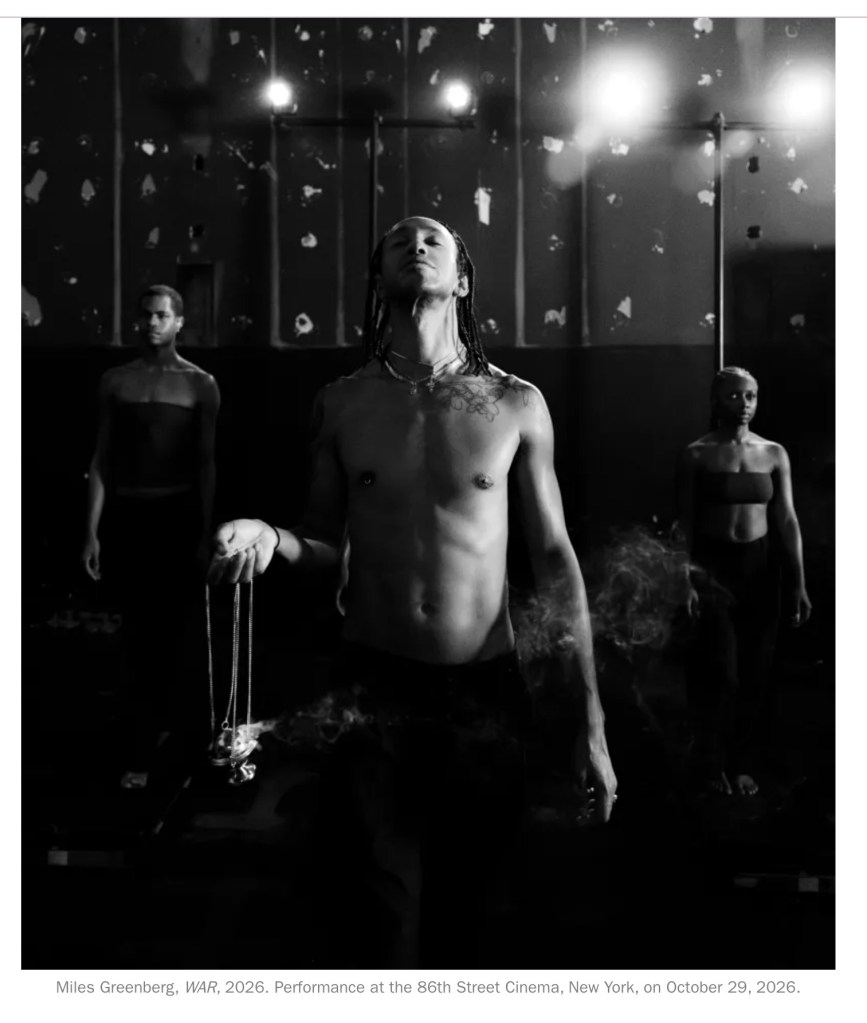
WAR ran for six hours on October 29, 2026, inside the former 86th Street Cinema on Manhattan’s Upper East Side, empty since 2019 and slated to become a Happier Grocery next year. Presented by Performa and curated by Zoe Lukov, it was the Canadian artist’s first New York performance in more than three years and his largest to date (Surface).
Greenberg, a protégé of Marina Abramović, treats the body as sculptural material. His past works include standing pierced by arrows for eight hours as Sebastian at the 2024 Venice Biennale, and walking a conveyor belt for 24 hours in Oysterknife (2020).
WAR scaled that walk up to an army. Some 44 Black performers, shirtless or in tube tops and earth-tone trousers, each with one eye clouded by a white contact lens, walked slowly on conveyor belts in two opposing phalanxes, a nod to the Qin dynasty’s terracotta warriors. Mirrors at the far end extended the ranks, and a central runway let visitors file between the two sides. Chino Amobi’s score mixed a soaring choir with synths, drums and sirens (Cultured).
The thurible on the treadmill
At the front of the formation, Greenberg walked shirtless holding a lit thurible. The sandalwood-sweet smoke reached visitors on the stairs before they saw a single body (Artnet).
The censer did real work in the piece:
- It made the room sacred. Smoke, flashes of red light and a score that at times evoked Gregorian chant gave a march of soldiers the aura of a liturgy of martyrs.
- It marked time. Like a priest replenishing incense through a long Mass, stagehands in black kept it lit. One critic likened a PA delivering a fresh thurible to a waiter bringing food mid-movie.
- It spread. In the final hour, staff handed smoking thuribles to the other performers, turning the army into a procession of thurifers in air already thick with sweat.
- It closed in prayer. As the score ended, Greenberg left his belt, walked the runway into a column of light, stood with arms outstretched, then folded them into the orans posture of prayer.
The thurible’s root word means “to sacrifice.” In WAR, the offering is six hours of bodily effort, and the smoke rising over it lets an ancient church object frame contemporary endurance as devotion.
Sources
- Cultured: Geoffrey Mak on WAR
- Artnet: Wet Paint
- Surface: WAR channels the terracotta army
- Wikipedia: Thurible
- Britannica: Thurible
- Holyart: Thuribles and boats


Leave a Reply